![An Australian Government Initiative [logo]](/images/austgovt_brown_90px.gif)



Aphanopetalum resinosum
 |
 |
Gum Vine
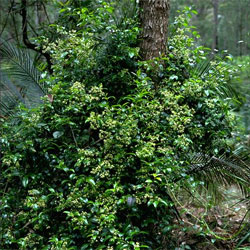
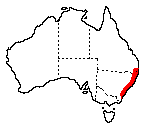
Aphanopetalum resinosum is a member of the family Cunoniaceae and was first described by the Austrian botanist Endlicher in 1839. It is a twining climber found in rainforest or wet forest areas of Queensland and New South Wales.
 A. resinosum, or Gum Vine, is one of two species of this
genus, both of which are endemic to Australia. The other species, A. clematideum, has a limited distribution in Western Australia between Geraldton and
Fremantle. A closely related genus is Ceratopetalum which
includes the NSW
Christmas bush, C. gummiferum.
A. resinosum, or Gum Vine, is one of two species of this
genus, both of which are endemic to Australia. The other species, A. clematideum, has a limited distribution in Western Australia between Geraldton and
Fremantle. A closely related genus is Ceratopetalum which
includes the NSW
Christmas bush, C. gummiferum.
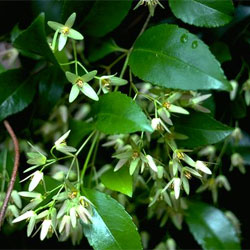
The foliage of A. resinosum is most attractive as the opposite leaves are a dark glossy green and up to 100 mm long. Leaf shape varies from ovate to lanceolate with bluntly toothed margins. Flowers are greenish yellow, 12 mm in diameter, and arise from the leaf axils in short cymes or loose panicles. The flowers appear to have 4 petals but these are in fact the sepals which enlarge to enclose the fruit as it develops. The petals are absent or minute, and flowering time is usually late spring to early summer. The fruit is a nut which is surrounded by the persistent calyx. Another identifying feature of this plant are the raised resinous dots on the stems.
Aphanopetalum resinosum is a useful foliage plant for shaded corners of the garden, with the added features of delicate flowers and attractive fruits. As a stem twiner it needs support to raise itself above ground level but if a rambling habit is preferred it will fulfil this role.
A well-composted soil is required and a light dressing of complete fertiliser in the spring should help maintain glossy healthy foliage. The plant is frost hardy and no pests or diseases have been noted in the Australian National Botanic Gardens. If the plant becomes woody and the foliage sparse with age it will respond well to heavy pruning. This is particularly relevant if the plant is used as a basket specimen. Heavy pruning should be undertaken prior to strong growth flushes, such as early spring and in summer after flowering. When used as a basket specimen the frequent application of a liquid fertiliser is advantageous.
Aphanopetalum resinosum can be propagated easily from semi-hard cuttings. It may also be propagated from seed if sown when fresh. It is not necessary to remove the persistent calyx lobes.
Text by: Fred Howe
Name meaning: Aphanopetalum resinosumAphanopetalum - from the Greek, aphanes, inconspicuous and petalon, a petal; resinosum - Latin for resinous. |