Systematics and Evolution (HA)
Floristic Systematics of the Australasian Flora
Program Leader: Brendan Lepschi
Malvaceae
 Researcher: Craven, Lyn (HRF) Researcher: Craven, Lyn (HRF)
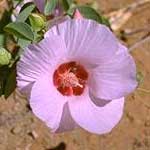
While species of Malvaceae usually are only locally dominant in Australian plant communities, the family nonetheless contributes significantly to biodiversity at both the generic and specific levels. Perhaps the best known genus of the family is Hibiscus, commonly cultivated in gardens for its showy flowers. Another significant genus is Gossypium which includes the important crop, cotton; a third of the species of this genus are endemic to Australia.
The tribe Hibisceae includes several economic plants, such as okra (Abelmoschus esculentus), kenaf (Hibiscus cannabinus) and hibiscus (H. rosa-sinensis). The taxonomy of the tribe is poorly known overall, although some groups have received attention because they contain economically important species (e.g. Abelmoschus, Hibiscus sect. Furcaria). Present research is focused upon three major areas: Hibisceae, phylogeny of Hibiscus sect. Furcaria, and floristic and taxonomic studies of selected taxa. Bernard Pfeil is re-evaluating the classification of Hibisceae using molecular and morphological data. The evolutionary relationships of the members of the tribe are of particular interest as the tribe previously has been associated with Bombacaceae and the presently recognised tribe Gossypieae. Recently obtained molecular data have indicated that Hibisceae may be paraphyletic and this will be explored further with additional sequences and morphological data. Curt Brubaker, Bernard Pfeil and Lyn Craven are collaborating with Randy Small, University of Tennessee, Knoxville, in studying the phylogeny and genome evolution of Hibiscus sect. Furcaria. This section is pan-tropical with c. 120 species of which c. 30 occur in Australia. Lyn Craven is revising the taxonomy of H. sect. Furcaria in Australia in collaboration with Doug Wilson, Tempe, and Paul Fryxell, Austin.
The 17 Australian species of Gossypium comprise three distinct groups recognised at sectional level within the genus, i.e. sects. Grandicalyx, Hibiscoidea and Sturtia. The three sections themselves are placed in a separate subgenus, subg. Sturtia. One species, G. sturtianum, Sturt’s Desert Rose, has been found to be both extremely variable and widespread. Its morphological and genetic variation is being studied by Curt Brubaker and Lyn Craven with the aim of explaining the evolutionary and biogeographical history of the species. Taxonomic concepts in the prostrate and semiprostrate species of sect. Grandicalyx are unclear and there is considerable overlap in morphological variation. Brubaker and Craven in collaboration with Mac Stewart, Arkansas, and Jonathan Wendel, Iowa, will use morphological and molecular data to demonstrate the evolutionary relationships within sect. Grandicalyx and devise a new taxonomy at species level.
Myrtaceae
Researcher: Craven, Lyn (HRF)
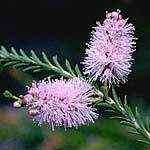 Melaleuca species occur throughout Australia, with a few species extending into Malesia and a few endemic species in New Caledonia. There are c. 260 species in the genus making it one of the larger such groups of Australian plants; the plants themselves range from being dwarf heathland shrubs to tall woodland trees. They are important elements in the monsoon woodlands, southern and eastern heathlands, and mallee shrublands in the southern arid zone. Species have potential for forestry, as sources of essential oils and other products, degraded-land reclamation, farm tree/windbreak plantings, and ornamental horticulture, among other applications. Taxonomic and floristic studies of Melaleuca and its relatives such as Conothamnus and Regelia are being co-ordinated by Lyn Craven. Species groups in Melaleuca that have high conservation and/or potential agronomic value are being investigated to elucidate their taxonomy; presently the M. uncinata (Broom bush) species complex is the subject of field- and laboratory-based studies in collaboration with Margaret Byrne, CALM, Perth. A survey of the essential oils of Melaleuca is under way with Joe Brophy, University of New South Wales, Sydney. A handbook and CD-ROM (the latter to include an interactive identification system) giving basic information on the botany, distribution, and chemistry of the genus is planned. Melaleuca species occur throughout Australia, with a few species extending into Malesia and a few endemic species in New Caledonia. There are c. 260 species in the genus making it one of the larger such groups of Australian plants; the plants themselves range from being dwarf heathland shrubs to tall woodland trees. They are important elements in the monsoon woodlands, southern and eastern heathlands, and mallee shrublands in the southern arid zone. Species have potential for forestry, as sources of essential oils and other products, degraded-land reclamation, farm tree/windbreak plantings, and ornamental horticulture, among other applications. Taxonomic and floristic studies of Melaleuca and its relatives such as Conothamnus and Regelia are being co-ordinated by Lyn Craven. Species groups in Melaleuca that have high conservation and/or potential agronomic value are being investigated to elucidate their taxonomy; presently the M. uncinata (Broom bush) species complex is the subject of field- and laboratory-based studies in collaboration with Margaret Byrne, CALM, Perth. A survey of the essential oils of Melaleuca is under way with Joe Brophy, University of New South Wales, Sydney. A handbook and CD-ROM (the latter to include an interactive identification system) giving basic information on the botany, distribution, and chemistry of the genus is planned.
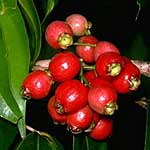 Syzygium has c. 60 species in Australia but is the largest genus of Myrtaceae in the Old World tropics with between 600 and 1000 species. The full range of the genus is from Africa east to the Hawaiian Islands and from India-southern China south to southeastern Australia and New Zealand. Many species are utilised as timber trees; other uses include cloves and cottage fruit trees. Syzygium especially is an important element in the rainforest ecosystem, being a food source for blossom-feeding and fruit-eating animals. There are significant problems to be resolved at generic level as doubts exist as to the validity of at least some of the presently recognised relatives (such as Acmena, Acmenosperma, Cleistocalyx, Piliocalyx, Waterhousea, etc). The taxonomy and morphology of the Australian and Malesian species is being studied by Lyn Craven (with Tom Hartley for those in Papuasia). The phylogeny is being studied with Paul Gadek, James Cook University, Cairns using both morphological and molecular data sets. Due to the inherent difficulties in writing identification keys for specimens lacking flowers and/or fruit, development of interactive identification systems is being given high priority. Syzygium has c. 60 species in Australia but is the largest genus of Myrtaceae in the Old World tropics with between 600 and 1000 species. The full range of the genus is from Africa east to the Hawaiian Islands and from India-southern China south to southeastern Australia and New Zealand. Many species are utilised as timber trees; other uses include cloves and cottage fruit trees. Syzygium especially is an important element in the rainforest ecosystem, being a food source for blossom-feeding and fruit-eating animals. There are significant problems to be resolved at generic level as doubts exist as to the validity of at least some of the presently recognised relatives (such as Acmena, Acmenosperma, Cleistocalyx, Piliocalyx, Waterhousea, etc). The taxonomy and morphology of the Australian and Malesian species is being studied by Lyn Craven (with Tom Hartley for those in Papuasia). The phylogeny is being studied with Paul Gadek, James Cook University, Cairns using both morphological and molecular data sets. Due to the inherent difficulties in writing identification keys for specimens lacking flowers and/or fruit, development of interactive identification systems is being given high priority.
 Rutaceae Rutaceae
Researcher: Tom Hartley: (HRF)
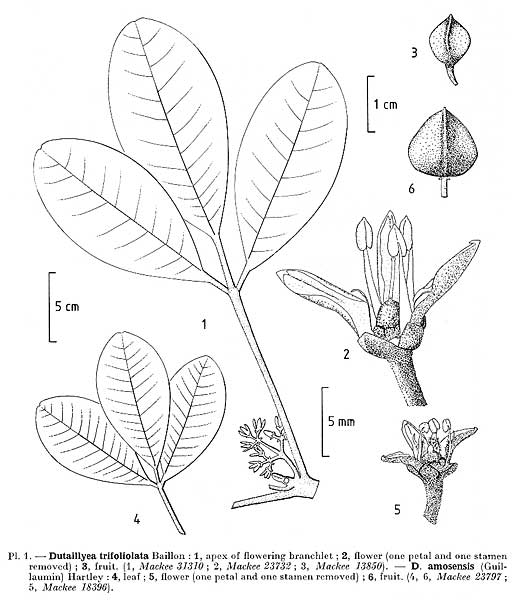
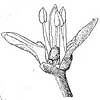
This study is concerned with the systematics of 32 of the 74 genera of Rutaceae which occur naturally in the Australasian-Malesian region. Excluded are the 25 genera which comprise the subfamily Aurantioideae in the region and the 17 genera which are believed (Hartley, 1995) to constitute the Australasian tribe Boronieae. Studies of the genera and their constituent species are based mainly on morphology (including that of the pollen) and focus primarily on traditional methods of analysis and presentation. They are concerned mainly with evolutionary relationships, identification, nomenclature, and biogeography. Most of the plants occur in the rain forest.
Citrus molecular studies
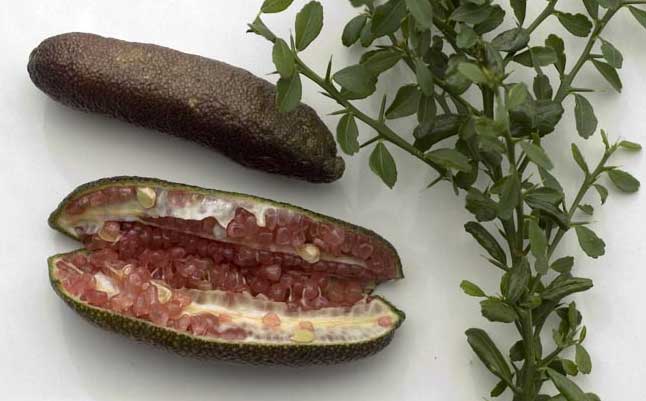
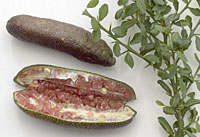 Citrus australasica fruit
 |
Researcher: Joe Miller
Molecular phylogenetics of the subfamiliy Aurantioideae, especially Citrus (staff: Cathy Miller, Ish Sharma). This study includes several strands. Initially cpDNA work lead by Randy Bayer will investigate relationships among aurantioid genera with a focus on Citrus. The classification of the group, especially the generic circumscriptions, will be reviewed. Molecular dating and biogeographic patterns will also be explored. This work will be extended to include more samples of non-Citrus aurantioids and a complete revision of the generic classification of the subfamily is envisioned.
The second strand of the aurantioid work is to explore nuclear DNA variation, especially among Citrus cultivars, wild species and relatives in closely allied genera such as Eremocitrus, Fortunella, Microcitrus, Poncirus. Multiple nuclear gene phylogenies are being generated to understand the complex inter-cultivar and wild species relationships within Citrus. Hybridisation has been a major component of Citrus breeding efforts, along with the preservation of near-primary hybridity through apomixis and vegetative propagation. This is an ideal group to explore the power of multiple nuclear genes and novel analysis methods to infer the history of these plants.
The third strand of work being carried out in Citrus is the testing of species boundaries among Australian native Citrus relatives using traditional and molecular taxonomic methods, including analysis of microsatellite variation. Recent work on cultivated Citrus using molecular data suggests that only a handful of species exist in the group. The variation promulgated by artificial selection in cultivated Citrus has made the application of traditional methods quite inconsistent (e.g., the the 15 or so species recognised by Swingle versus the 150 or species recognised by Tanaka). The molecular taxonomy is, however, much closer to groups that are inter-fertile, which suggests that these methods could be very useful in taxonomically confused groups. Native Citrus relatives have not been included in the molecular work so far. Some methods using molecular data are fairly recent and would benefit from thorough examination and comparison to traditional methods. The wild species that are found in Australasia appear to be free of artificial selection (apart from within the last decade or so) and therefore could be a good group to test the newer methods against traditional ones.
Research Goals:
- Citrus and Aurantioideae phylogeny based on 10kb of cpDNA sequence and the implications for classification
- Citrus phylogeny using multiple nuclear genes to examine past hybridisation and further inform classification decisions.
- Native Citrus species delimitation using molecular taxonomy
- Radiation of Australasian Citrus and subfamily Aurantioideae examined using molecular dating
 Santalaceae Santalaceae
Researcher: Lepschi, Brendan
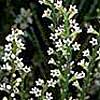
My research on the Santalaceae is focused on the Australian elements of the tribe Amphorogyneae. The Amphorogyneae comprises ten genera of aerial and terrestrial parasitic shrubs and climbers, extending from Asia to Australia, with its centres of diversity in Malesia, and (to a lesser extent) Australia. Three genera, Choretrum (c. 6 spp.), Leptomeria (17 spp.) and the monotypic Spirogardnera, are endemic to Australia, where they are widespread throughout the southern half of the continent. Unlike some of the more showy members of the Australian flora, Choretrum and its relatives have not attracted a great deal of taxonomic attention. Consequently, little systematic work has been undertaken on these plants, and their taxonomy and phylogenetic relationships are not well understood. A taxonomic revision of Leptomeria has recently been completed, and the immediate aim of this work is to undertake a similar revision of Choretrum. These treatments will provide a basis for the longer-term aims of the project, which include a re-assessment of the generic boundaries between Choretrum, Leptomeria and Spirogardnera, and production of species-level phylogeny for this group of taxa.
 Pteridophytes Pteridophytes
Researcher: Croft, Jim
A dry continent, Australia is not as rich in ferns and allied species as the wet, tropical lands to our north. Nevertheless, a number of species have adapted to semi-arid conditions. These areas and the wetter forests, helped by the wide latitude range of the continent, support a flora of c. 456 species in 112 genera; c. 95-100 of these species are considered endangered, vulnerable, rare or poorly known, and most of these survive in isolated populations in N Queensland. The focus of this project is the documentation and visualization of the pteridophyte flora of the Australasian and Papuasian regions by developing and implementing a range of bioinformatic solutions to handling botanical data, based primarily on the collections and databases of the Australian National Herbarium. In addition to internal database access, external public Internet gateways provide access to plant name information and distribution and occurrence information, including dynamically generated maps; images of pteridophytes are being added to these resources. On-line descriptions and keys to Australasian and Papuasian pteridophyte families and genera are being developed and made available on the Internet and a descriptive character list has been developed for pteridophytes and a DELTA dataset is being populated for the c. 300 families and genera of ferns and fern allies of the world with a view to building an interactive Internet key.
Verbenaceae
Lantana (Lantana spp.) as Environmental Weeds (TRIN - CERF Project)
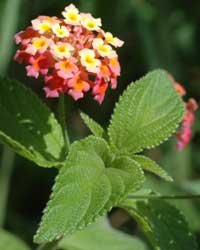
Lantana (Lantana camara and affiliates) has been targeted for the initial systematics and diversity studies. Originating in the Americas, Lantana is now a serious weed of natural environments, pastures, and farmland throughout the tropics and sub-tropics. Heavy lantana infestations occur along almost the entire East coast of Australia and patchy outbreaks occur in the Northern Territory and Western Australia. Biological control is the only practical method of controlling this weed, yet although many (> 41 worldwide and 28 within Australia) biocontrol agents have been applied little success has been achieved. Research is needed to determine the origins and genetics of the many Lantana varieties that have been introduced to Australia so as to properly target biocontrol agent discovery efforts.
We are conducting research on Lantana with three overarching objectives:
- The establishment of the identity, diversity and origins of the various forms established in this country.
- The production of molecular and morphological based evaluations of species and genetic diversity to assess phylogenetic relationships and implications for selection of biocontrol agents.
- An assessment of the amount of interpopulation/race genetic variation of this weed species within Australia and the processes that structure this variation.
The project is using the collection resources of the Australian National Herbarium and its partner agencies in the Taxonomy Research & Information Network (TRIN) together with those of weed management agencies. We maintain an active collaboration with entomologist Dr Michael Day of QLD Department of Primary Industries. We are employing a variety of molecular genetic techniques, including DNA sequencing, microsatellites and AFLPs, in order to identify genetic markers for analysis of the evolution and introduction history of lantana. We intend to adapt and employ these techniques for use in the study of the origins and relationships of the progenitors of other introductions to Australia and the implications for selection of biocontrol agents.
 Visit the National Research & Information Network (TRIN) website for Lantana Visit the National Research & Information Network (TRIN) website for Lantana
|