![Director of National Parks [logo]](../../../../images/dnp_90px.gif)


Igniting interest in Central Australian plants | The Central Meeting Place | Boom and Bust in the Red Centre | Images - the Making of the Red Centre Garden | Background
Imagine yourself wandering through the Red Centre
from its vast sand plains and dunes, rocky escarpments and breakaway country, to desert rivers and the gibber plains.
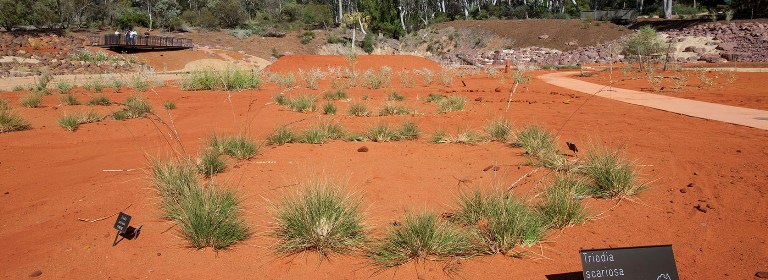
Experience a selection of plants from Central Australia’s iconic and dominant plant communities, including the mulga country, the majestic desert oaks, ghost gum woodlands, spinifex grasslands and saltbush scrub.
The Red Centre Garden draws its inspiration from the area of Central Australia that lies within a 500 km radius of the town of Alice Springs. This encompasses the northern parts of South Australia, western Queensland, Uluru-Kata Tjuta National Park, and southern parts of the Northern Territory almost to Tennant Creek. The Uncovering the Red Centre exhibition provides a glimpse into the culture and plants of this region.
The Red Centre Garden showcases the iconic significance of the continent's Red Centre as the physical and spiritual heart of Australia, right here in the nation's garden within the nation's capital.
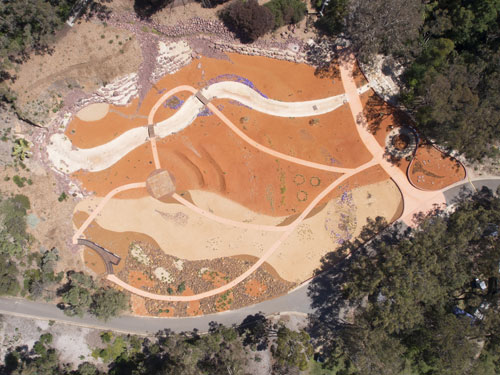
Aerial view of the Red Centre Garden
Igniting interest in central Australian plants
The vision behind the Red Centre Garden is to inspire appreciation for Australia’s unique desert plants and landscapes. The garden inspires a ‘sense of place’ connecting people to some of the iconic plants and landscapes of central Australia through a memorable and educational experience.
The story themes integrate elements of the ephemeral nature of this country, the indigenous connection to country and prominent plant species and plant communities.
The design is visually stunning - simple yet dramatic - combining elements of the natural beauty of the Red Centre landscapes with aspects of contemporary landscape design.
The Central Meeting Place
A centrepiece of the Red Centre Garden, the Central Meeting Place features an Indigenous artwork pavement that fives a stunning interpretation of country, by Indigenous artist Teresa Pula McKeeman.
Teresa was commissioned by the Gardens in 2012 to work with Pamille Berg Consulting Pty Ltd and the Gardens' staff to evolve a selected portion of one of her painted designs into the pavement design for this Garden. Teresa travelled to Canberra in late 2012 to spend time on the construction site, discussing and approving fabrication materials and finalising the design.
Teresa describes her painted design as follows:
"This painting is about the ceremonial dancing, but only the women can attend these ceremonies, performing sacred dance and songs. The younger girls are taught the dance movements, song, dreaming designs, and stories. "The women's dancing has been done for many years at the ceremonial site. This painting represents the dance tracks that are left by the women. I... have applied my own style to depict the site and stories that have been passed onto me. "I was inspired to start painting in the 1990s with my mother after spending years at my homelands of Utopia, where I witnessed and took part in ceremonies and was taught my dreamings. I was surrounded at that time by artists such as my mother Barbara Weir and my aunty Gloria Petyarre."
Born in 1964, Teresa lives and paints in the traditional country of her mother and grandmother on the out-station at Atnwengerrp, 40 km from the central Utopian or Alywarr community of Ampilatwatja in the Northern Territory.
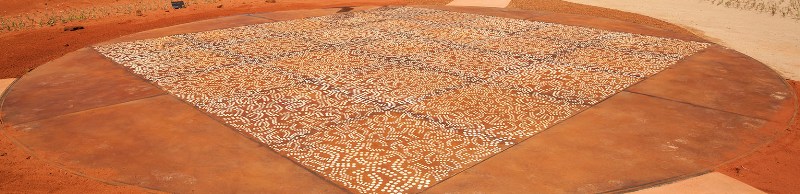
Artwork by Teresa Purla McKeeman
Boom and Bust in the Red Centre – survive or perish
The central concept of Boom and Bust ecology in the Red Centre invites people to take a closer look at how plants, animals and people have survived and adapted to the desert’s extreme variability in rainfall.
All the elements in the garden are invested with meaning, so that visitors become immersed in an interpretive space. Patterned and timed plantings replicating boom and bust cycles, interpretive signs, sculptures and decorative elements show, explain and celebrate the details of desert life.
The garden features and interprets plants that have developed specific adaptations to desert extremes.
Visitors can also get a glimpse of some desert animals, their relationships with desert plants, and their adaptations to dry climates.
A children’s trail of desert discovery will spark curiosity as children track animals throughout the garden and learn along the way. Tracks, burrows, hollows and nests will intrigue young visitors to find the animals that made them.