
Council of Heads of Australasian Herbaria
Australian National Herbarium
Biographical Notes

|
|
Council of Heads of Australasian Herbaria | |
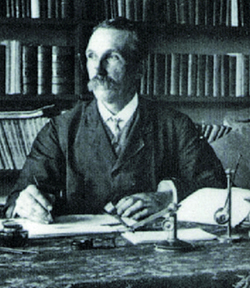 Musson, Charles Tucker (1856 - 1928)
He was born in Nottingham, England on 14 December 1856; died on 9 December 1929 at Gordon, Sydney, NSW.
His father was a
manufacturer of hosiery and embroidery.
After
attending Nottingham Grammar School, Musson himself worked as a 'hosiery manager', later
describing an extensive experience in business management.
He was also a committed naturalist,
particularly interested in 'collecting, mounting
and classifying land and fresh-water shells and
collecting and painting fungi'.
He studied for certificates in botany,
geology, physical geography, biology and physiography through the Cambridge University
Extension Lectures, inaugurated in Nottingham
in 1873, and was employed for several years
as a lecturer in Botany at the University College in Nottingham.
Charles and his mother migrated to Australia, arriving in Sydney on board
the Surat on 30 April 1887.
When he first arrived in NSW,
he assisted his brother-in-law in his business, living for a year at Narrabri and a year at
Tamworth before moving to Sydney.
In August 1887 Musson travelled to Queensland on an expedition to locate, examine and
collect mollusca, sponsored by Dr J. C. Cox,
FLS, an influential molusc naturalist.
By 1891 Musson had become known to naturalists and scientists in NSW Andrew
beyond and was corresponding with the Victorian botanist, Ferdinand von Mueller, sending
him plant specimens for identification.
He
presented a paper to the Australasian Association for the Advancement of Science (AAAS)
in Melbourne in January 1890 calling for the
publication of 'A Critical List of the Australian
Fauna and Flora' that he hoped would address problems faced by Australian naturalists in their
research.
The NSW Department of Agriculture was established in 1890 and its journal,
the Agricultural Gazette, commenced in July
of that year. Land for a college was chosen at
Ham Common, Richmond, some distance from
Sydney but accessible by the railway.
When the Hawkesbury Agricultural
College opened at Richmond, NSW,
in 1891, Musson aged 34, was appointed Science Master at the newly formed College, commencing his duties as "registrar and lecturer on botany" on Monday 23rd March 1891 and delivering his first lecture the very next day.
He taught subjects such as 'Elementary Botany', 'Book-keeping', 'English and Arithmetic', and was an important advocate for 'nature study' in NSW schools.
By the turn of the century Musson's title changed to 'Lecturer in Botany and Entomology' and thence to 'Science Master' in 1909.
He continued to influence Nature Study
in the decade 1911 to 1920 through important publications such as 'Nature Studies: Suggestions
for Teachers' which provided a practical text for teachers
in NSW that consistently used examples from Australian nature.
Apart from his continuing contributions to the
teaching and promotion of Nature Study in
schools, Musson remained a busy member of
the Hawkesbury Agricultural College staff in
the decade from 1911 to 1919.
When Musson retired from the College at the
end of 1919, the College Journal commented
upon his 'numerous' writings: "These exhibit
the patient, thoughtful investigations and restless
energy of the gifted author".
In retirement, Musson
continued to lecture and write. Lectures given
at the Easter Show in Sydney and authoritative articles contributed to the Sydney Morning
Herald addressed the topic of conservation of
resources.
He died at his home in Gordon, NSW, on 9 December 1929 and was cremated at the Rookwood Crematorium with a Minister of the Liberal Catholic
Church officiating. Cremation had been advocated by Theosophists for many years but only
became available at Rookwood in 1925.
Source: Extracted from:
Dorothy Kass, 'The Nature Study Idea in New South Wales: The Role
of Charles Tucker Musson (1856-1928)',
Historical Records of Australian Science, Volume 24 Number 2,
Australian Academy of Science, 2013
The Sydney Morning Herald (NSW)
Tue 11 Dec 1928
Page 10
Family Notices - MUSSON
https://collections.westernsydney.edu.au/nodes/view/36355
Portrait Photo: Historical Records of Australian Science above.
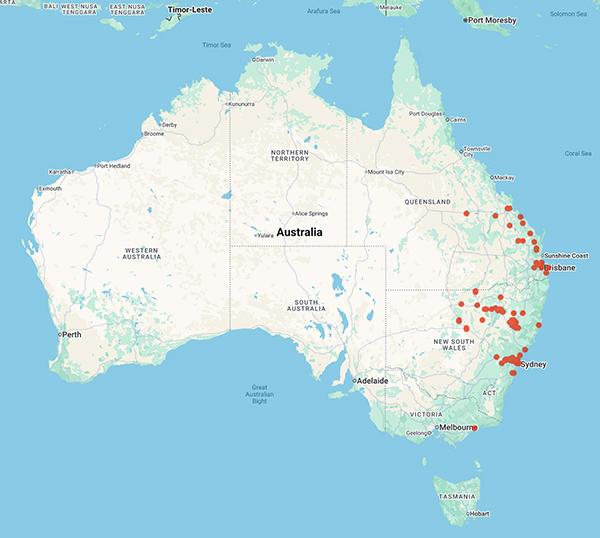
Data from 724 specimens