
Council of Heads of Australasian Herbaria
Australian National Herbarium
Biographical Notes

|
|
Council of Heads of Australasian Herbaria | |
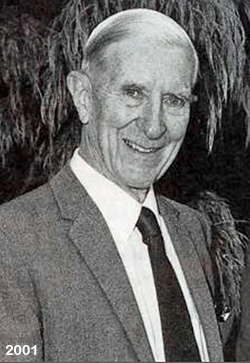 Cribb, Alan Bridson (1925 - )
Born 5 October 1925 in Ipswich, Queensland;
He is the son of Alan Bridson Cribb, a grazier and his wife, Dorothy Shand.
He grew up around Longreach and his father instructed him in a love for the Australian bush and an interest in natural history. The extended Cribb family lived in Ipswich, where the family business Cribb & Foote department store was located.
He studied at the University of Queensland, taking his BSc with first class honours in 1948.
He collected algae on a UQ Science Students excursion to Noosa Heads in 1948, and this collection was used to forward his future field of study.
He travelled to New Zealand where he studied under Professor Val Chapman, before moving into his Honours program. He took up a position as a demonstrator in the Department of Botany and worked with visiting academic Dr Tore Levring of Sweden studying marine algae on Heron Island.
He was appointed a research officer with the CSIRO Division of Fisheries and Oceanography at Cronulla in 1950. He escorted Professor Lily Newton, a British expert in seaweeds, when she came to Australia at the invitation of CSIR (now CSIRO) in 1950. He spent two years reviewing algae, especially Macrocystis from Tasmania.
He returned to Queensland in 1952, taking up work as a botany lecturer at the University of Queensland. He took his PhD in 1958.
He was Head of the Department of Biology from 1978 to 1982 and remained in the department until his retirement in 1988.
He and his wife, researcher Dr Joan Cribb completed two volumes on bush and wild foods, with material from Desmond Herbert and notes from Raymond Specht's Arnhem Land Expedition of 1948.
He was winner of the 2001 Australian
Natural History Medallion, nominated by The Queensland
Naturalists' Club for an outstanding contribution to natural history over a period of
fifty years, culminating in his publication of the field guide Seaweeds of Queensland in 1996.
He led many field excursions
for the Queensland Naturalists Club and
other groups and is a much appreciated
exhibitor at Club meetings.
In retirement
since 1988, he continued to promote
public awareness of the contribution of
plants to human welfare and their importance and role in biodiversity.
Source: Extracted from:
https://en.wikipedia.org/wiki/Alan_Cribb
The Victorian Naturalist Volume 119 (1) February 2002, p.38
Portrait Photo: The Victorian Naturalist Volume 119 (1) February 2002 (front cover).
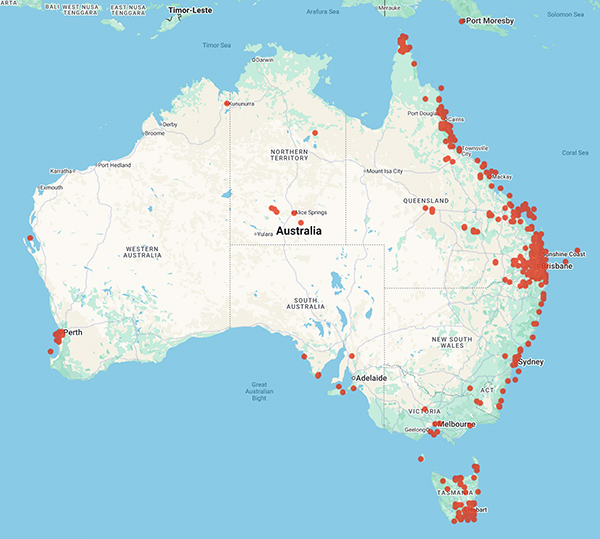
Data from 11,517 specimens