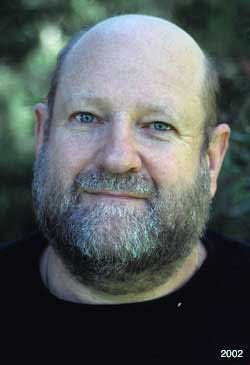
 Chapman, Arthur David (1947–)
Born 18 September 1947 at Blayney, NSW.
His parents Harry William Chapman and Linda Rebecca Worboys were farmers and graziers.
He attended Hurlstone Agricultural High in Glenfield, NSW.
Completed a BSc at James Cook University, North Queensland in 1973 while employed by the University (1969–73)
Employed by the Australian Academy of Science 1974–76.
Private funding from Sir Maurice Mawby was made available to the Australian Academy of Science, funding preliminary work on a 'Flora Project'. Leadership of this project fell to Nancy Burbidge, and one of the first tasks was production of an Australian Plant Name Index (APNI).
Compilation of APNI began in April 1973, with the appointment of Penelope Hack as bibliographer, and she was succeeded in January 1974 by Arthur Chapman. He worked alongside Helen Hewson who was commissioned to prepare a sample treatment of Brassicaceae as a model for the Flora of Australia.
When the Bureau of Flora & Fauna (later the Australian Biological Resources Study [ABRS]) was officially established in 1977, Chapman and Hewson became two of its foundation staff.
Arthur worked on APNI for 17 years, producing one of the world's largest and most detailed nomenclators for vascular plants in modern times. The work was pubished in 4 volumes in 1991. It contained over 62,350 names of taxa at ranks ranging from genus to variety.
Arthur later reminisced:
". . . while working in EA [Environment Australia] in its early days in the Wales Centre in Civic [Canberra]. We worked on old 'Decstation78' computers with a fixed keyboard and 8.5-inch floppy discs. This was a computer screen and keyboard all in one and was a great way to get RSI [Repetitive Strain Injury]—we had a lot of staff suffer RSI in those days.
The building also had synthetic carpets and if someone walked within a metre or so of a computer it would crash [due to static electricity]. We had to have watering cans to water the floor every few hours and requested that staff not wear nylon underwear.
How things have changed: I came across the specifications for one of those computers recently. Among other things, the specifications included—and this was pretty high-tech for the time:
1. At least 16,000 characters of usable memory
2. A Cathode Ray Tube display unit, with keyboard
3. A printer which will output both upper and lower case
characters
4. On-line storage of approximately 500,000 characters".
From ABRS, Arthur moved on to another organisation, the Environmental Resources Information Network (ERIN), in the 1990s where he was the Scientific Co-ordinator of Biogeographic Information and became involved in the development of some very innovative GIS tools.
After this Arthur became an Environmental Consultant working out of Ballan in Victoria. He worked extensively on data quality and on several international projects for the Global Biodiversity Information Facility (GBIF), Biodiversity International and UNEP as well as on data quality and species and environmental modelling in many countries.
He spent one year in Brazil with the Reference Centre for Environmental Information and from 1999 was a member of the Scientific Advisory Committee for FAPESP/Biota, the biodiversity funding organisation in São Paulo, Brazil.
Interests
Wildlife Photography, History of British migration to Australia in the 19th Century; History of Australian Botany—including the development and maintenance of a large database of Australian plant collectors; cricket as an International scorer.
Currently lives in Ballan, Victoria.
Sources:
ABRS 'Biologue', No.27 Oct. 2002, p.13.
Pers. Comm. Arthur Chapman, 2004, 2007, 2014
Portrait Photo: 2002 M.Fagg, now ANBG photo collection
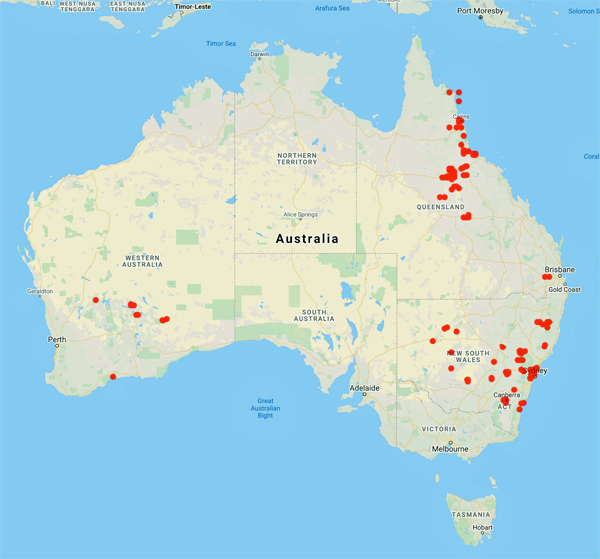
Collecting localities for 'Chapman, A.D.' from AVH (2021)
Data from 1,128 specimens
Publications
Arthur has published over 200 papers on a range of biological topics. His major publication is the four volume, Australian Plant Name Index which details bibliographic information on the more than 60,000 names that have been applied to Australian plants. This data is now maintained online. Some of his more important publication are detailed below.
Note that several of the data quality and georeferencing publications are also published in languages other than English, including Spanish, Korean, Chinese and French.
- "Proposals on valid publication and the report of the Special Committee on Valid Publication". Taxon 35: 756-779 (1986)
- "Proposals to expedite nomenclature". Taxon 35: 823 [with R.J. Hnatiuk] (1986)
- "Domin and Danes in Java and Australia 1909-1910". in P.S.Short (ed.) History of Systematic Botany in Austalasia Proceedings of a symposium held at the University of Melbourne, 25-27 May 1988 pp. 159-163 (1990)
- "Australian Plant Name Index A-C". Australian Flora and Fauna Series No. 12. Canberra: AGPS. i-xxii, 1-898 (1991)
- "Australian Plant Name Index D-J". Australian Flora and Fauna Series No. 13. Canberra: AGPS. i-xi, 899-1710 (1991)
- "Australian Plant Name Index K-P". Australian Flora and Fauna Series No. 14. Canberra: AGPS. i-xi, 1711-2476 (1991)
- "Australian Plant Name Index Q-Z". Australian Flora and Fauna Series No. 15. Canberra: AGPS. i-xi, 2477-3056 (1991)
- "Quality control and validation of point-sourced environmental resource data" pp.409-418 inLowell, K. and Jaton, A. (eds). Spatial Accuracy Assessment: Land Information Uncertainty in Natural Resources. Chelsea, Michigan: Ann Arbor Press. (1999)
- "Gathering Data - Creating Information". The importance of data accuracy and data-sharing" in L.Giddings (ed.) Memorias del Simposio. Manejo de Datos de Diversidad Biologica y de Conservacion pp. 13-18. Xalapa: Instituto de Ecologia (1993)
- "Linking Plant Species Information to Climate Modelling for Continental Biodiversity Inventory and Monitoring" in R.I.Miller (ed.) Mapping the Diversity of Nature London: Chapman and Hall [with J.R.Busby] (in press: 1994)
- "Principles of Data Quality". Report for the Global Biodiversity Information Facility 2005. 61pp. Copenhagen: GBIF. (2005) http://www.gbif.org/orc/?doc_id=1229
- "Principles and Methods of Data Cleaning". Report for the Global Biodiversity Information Facility 2005. 75pp. (2005) Copenhagen: GBIF. http://www.gbif.org/orc/?doc_id=1262
- "Uses of Primary Species-Occurrence Data". Report for the Global Biodiversity Information Facility 2005. 111pp. (2005) Copenhagen: GBIF. http://www.gbif.org/orc/?doc_id=1300
- "Guide to Best Practices for Georeferencing". BioGeomancer Consortium. Copenhagen: Global Biodiversity Information Facility. 90pp. (with Wieczorek. J. 2006). http://www.gbif.org/orc/?doc_id=1288.
- “Guide to Best Practices for Generalizing Sensitive Species-Occurrence Data”, version 1.0. Copenhagen: Global Biodiversity Information Facility. 27pp. (with. Grafton, O. 2008) http://www.gbif.org/orc/?doc_id=1233
- “Numbers of Living Species in Australia and the World” 1st edn 61pp (2006); 2nd edn. 80 pp. Canberra: Australian Biological Resources Study (2006) http://www.environment.gov.au/biodiversity/abrs/publications/other/species-numbers/2009/pubs/nlsaw-2nd-complete.pdf
- “Report of the Special Committee on Electronic Publication”. Taxon 59(6): 1853-1862.(with Turland, N.J. and Watson, M.F. 2010) http://www.ingentaconnect.com/content/iapt/tax/2010/00000059/00000006/art00016].