Alternatively Capparaceae
Including Cleomaceae Horan. (p.p.), Physenaceae Takhtajan (pro tempore)
Excluding Cleomaceae, Koeberliniaceae, Pentadiplandraceae
Habit and leaf form. Trees, or shrubs, or lianas, or herbs (rarely); non-glandular, not resinous. `Normal' plants. Self supporting, or climbing. Xerophytic (commonly), or mesophytic. Leaves alternate; spiral, or distichous (rarely); petiolate; non-sheathing; gland-dotted, or not gland-dotted; simple, or compound; when compound, palmate. Lamina when simple dissected, or entire; when simple/dissected, palmately lobed. Leaves stipulate, or exstipulate (stipules small). Stipules (when present) often spiny (or represented by glands). Lamina margins often involute. Leaves without a persistent basal meristem.
Leaf anatomy. Stomata present; anomocytic.
Lamina dorsiventral to centric. The mesophyll with sclerencymatous idioblasts, or without sclerenchymatous idioblasts. Minor leaf veins without phloem transfer cells (Capparis, Steriphoma).
Stem anatomy. Cork cambium present; initially deep-seated, or superficial. Nodes unilacunar. Cortical bundles (secondary, pericyclic) present, or absent. Medullary bundles absent. Internal phloem absent. Secondary thickening developing from a conventional cambial ring, or anomalous; via concentric cambia (often), or from a single cambial ring. `Included' phloem present (often), or absent. Xylem with fibre tracheids, or without fibre tracheids; with libriform fibres. Vessel end-walls simple. Vessels with vestured pits. Wood partially storied; parenchyma paratracheal. Sieve-tube plastids P-type, or S-type; when P-type type I (b).
Reproductive type, pollination. Hermaphrodite, or dioecious. Entomophilous.
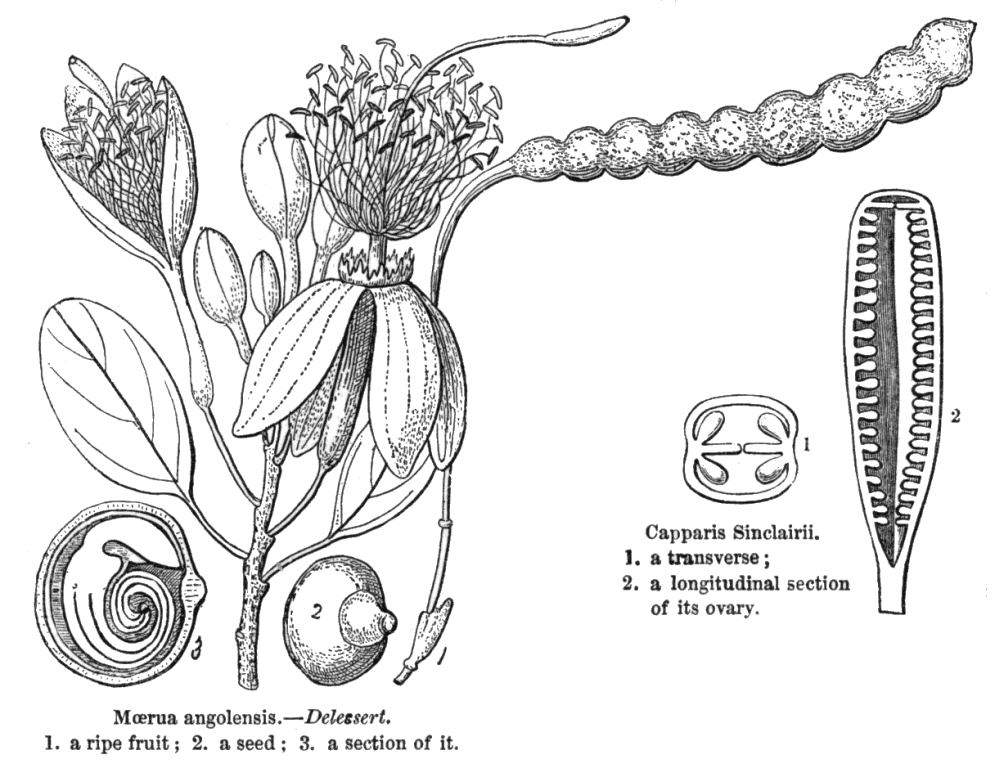
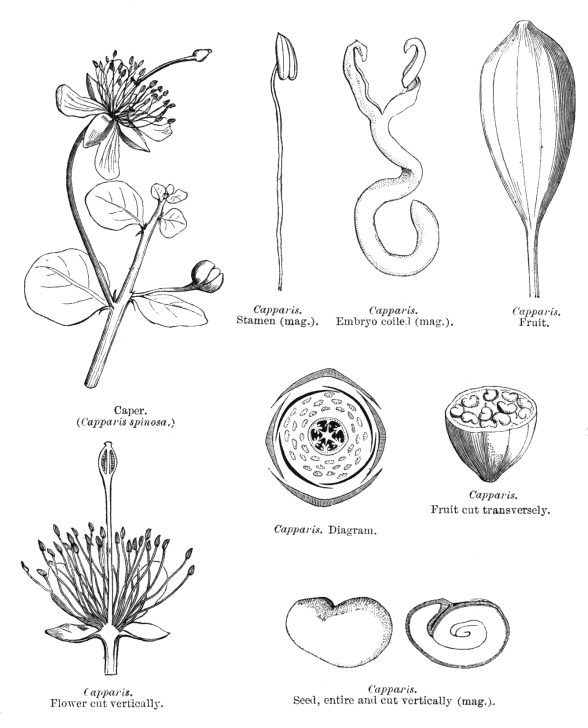
Inflorescence, floral, fruit and seed morphology. Flowers aggregated in `inflorescences'; usually in racemes. The terminal inflorescence unit racemose. Inflorescences usually in racemes. Flowers bracteate; ebracteolate; regular to somewhat irregular; usually 4 merous. Floral receptacle developing a gynophore, or developing an androphore and developing a gynophore (causing the pistil to project). Hypogynous disk present; of separate members (a ring).
Perianth with distinct calyx and corolla; 8; 2-4 whorled (more or less resolvable into K2+2 and C2+2); isomerous. Calyx 4 (2+2); 2 whorled; basally gamosepalous, or polysepalous; bilabiate, or regular; imbricate. Corolla 4 (diagonal, very rarely 2); 2 whorled (2+2); polypetalous (the petals equal or unequal, sometimes hooding).
Androecium basically 4, or 6-100 (i.e. to `many', when branched). Androecial members branched (commonly), or unbranched; when branched, maturing centrifugally; free of the perianth; all equal to markedly unequal; basally coherent, or free of one another. Androecium exclusively of fertile stamens, or including staminodes (or with staminodal branches). Stamens 4, or 6-20; not didynamous, not tetradynamous; isomerous with the perianth to diplostemonous to polystemonous; basically oppositisepalous; filantherous, or petaloid and filantherous. Anthers dorsifixed to basifixed; dehiscing via longitudinal slits; introrse; tetrasporangiate. Endothecium developing fibrous thickenings. Anther epidermis persistent. Microsporogenesis simultaneous. The initial microspore tetrads tetrahedral, or decussate. Anther wall initially with more than one middle layer. Tapetum glandular. Pollen grains aperturate; (2-)3(-4) - aperturate; colporate (colporoidate); 2-celled (usually), or 3-celled.
Gynoecium 2, or 10-12 (by dédoublement); syncarpous; eu-syncarpous; superior. Ovary 1 locular (usually), or 2 locular (by false septa). Gynoecium when G=2 transverse. Ovary generally stipitate. Gynoecium non-stylate, or stylate. Styles 1; attenuate from the ovary; apical; shorter than the mature ovary. Stigmas 1; dry type; papillate, or non-papillate; Group II type. Placentation when unilocular, parietal; when bilocular, parietal. Ovules in the single cavity 10-100 (`many'); when bilocular, 30-50 per locule (`many'); arillate, or non-arillate; anatropous to campylotropous; bitegmic; crassinucellate. Outer integument contributing to the micropyle, or not contributing to the micropyle. Embryo-sac development Polygonum-type. Polar nuclei fusing prior to fertilization. Antipodal cells formed; 3; not proliferating; ephemeral (usually small, large in Maerua). Synergids hooked (sometimes with filiform apparatus). Endosperm formation nuclear. Embryogeny onagrad, or solanad.
Fruit fleshy, or non-fleshy; dehiscent, or indehiscent; a capsule, or a berry, or a drupe, or a nut, or a samara. Seeds endospermic, or non-endospermic. Cotyledons 2 (oily). Embryo variously curved, or bent; 1 the length of the seed, or 2 the length of the seed.
Seedling. Germination phanerocotylar.
Physiology, biochemistry. Mustard-oils present. Cyanogenic, or not cyanogenic. Alkaloids present (21 species). Iridoids absent. Proanthocyanidins absent. Flavonols absent. Ellagic acid absent (Euadenia). Aluminium accumulation not found. C3. C3 recorded in Cadaba, Capparis, Maerua. Anatomy non-C4 type (Boscia, Capparis).
Geography, cytology. Temperate to tropical. Widespread. X = 10, 11, 17.
Taxonomy. Subclass Dicotyledonae; Crassinucelli. Dahlgren's Superorder Violiflorae; Capparales. Cronquist's Subclass Dilleniidae; Capparales. Takhtajan's Subclass Dilleniidae; Dillenianae; Capparales. Species 650. Genera about 26; Apophyllum, Bachmannia, Belencita, Borthwickia, Boscia, Buchholzia, Cadaba, Capparis, Cladostemon, Crateva, Dactylaena, Dipterygium (or Cruciferae?), Euadenia, Forchhammeria, Maerua, Morisonia, Neothorelia, Podandrogyne, Poilanedora(?), Puccionia (or Cruciferae?), Ritchiea, Setchellanthus, Steriphoma, Stixis, Thilachium, Tirania.
Illustrations. cappa357.gif cappa233.gif