~ Liliaceae
Habit and leaf form. Rushlike herbs. Leaves much reduced (to sheaths). Perennial; with a basal aggregation of leaves; shortly rhizomatous. Xerophytic. Leaves alternate; spiral; sheathing. Leaf sheaths with free margins. Leaves simple; exstipulate.
Leaf anatomy. Stomata anomocytic.
The mesophyll containing calcium oxalate crystals, or without calcium oxalate crystals (? - raphides present in the stem cortex). Vessels absent.
Stem anatomy. Secondary thickening absent. Xylem without vessels.
Root anatomy. Root xylem with vessels. Vessel end-walls scalariform and simple (mainly simple).
Reproductive type, pollination. Hermaphrodite. Floral nectaries present. Nectar secretion from the gynoecium (from septal nectaries).
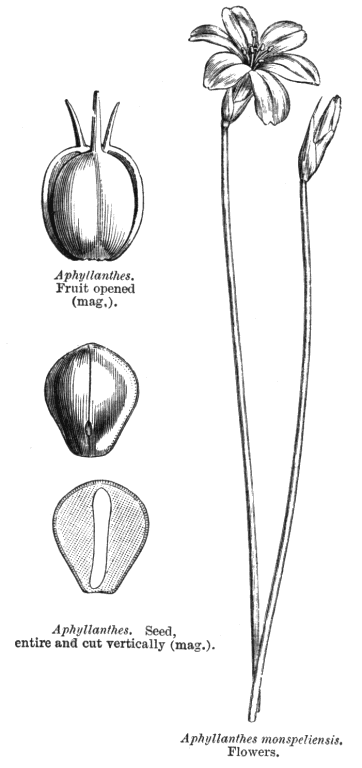
Inflorescence, floral, fruit and seed morphology. Flowers solitary, or aggregated in `inflorescences'; when aggregated, in panicles (these reduced). Inflorescences scapiflorous; of 1-2(-3) flowers terminating each of the wiry, assimilatory scapes; with involucral bracts. Flowers bracteate (each flower enclosed by one or two free and five basally fused scales); ebracteolate; regular; 3 merous; cyclic; pentacyclic. Perigone tube present.
Perianth of `tepals'; 6; joined; 2 whorled (3+3); isomerous; petaloid; similar in the two whorls (the lobes narrowly elliptic-oblong); blue.
Androecium 6. Androecial members adnate (at the mouth of the perigone tube); free of one another; 2 - whorled. Androecium exclusively of fertile stamens. Stamens 6; diplostemonous. Anthers dorsifixed (epipeltate); dehiscing via longitudinal slits; introrse; tetrasporangiate. The thickenings spiral. Microsporogenesis successive. Pollen grains aperturate; spiraperturate.
Gynoecium 3. Carpels isomerous with the perianth. Gynoecium syncarpous; synstylovarious; superior. Ovary 3 locular. Gynoecium stylate. Styles 1; attenuate from the ovary; apical. Stigmas 3; dry type; papillate. Ovules 1 per locule; anatropous; crassinucellate. Endosperm formation helobial.
Fruit non-fleshy; dehiscent; a capsule. Capsules loculicidal. Seeds endospermic. Embryo well differentiated. Embryo straight; as long as the endosperm. Testa thinly encrusted with phytomelan.
Physiology, biochemistry. Alkaloids absent. Proanthocyanidins absent. Flavonols absent. Ellagic acid absent. Saponins/sapogenins present.
Geography, cytology. Holarctic. West Mediterranean.
Taxonomy. Subclass Monocotyledonae. Superorder Liliiflorae; Asparagales. Species 1 (Aphyllanthes monspeliensis). Genera 1; Aphyllanthes.
Illustrations. aphyl862.gif